

On Tuesday, April 15, during community lunch, a Capital Projects Bond presentation took place in the little theater. The school board student representatives, Anish Mehta ’26 and Lucy Eisenberg ’27, presented alongside SHS Principal Kenneth Bonamo to answer student questions and concerns. Astonishingly, beside myself—who attended the meeting to write about it—there were no attendees. No one cared enough to show up.
The Scarsdale School District’s proposed Capital Projects Bond calls for $101,707,875, to be repaid with taxpayer dollars. This unusually large sum is over one hundred million dollars, that if passed, would be spent repairing, adding, and strengthening the Scarsdale School District. The bond hopes to improve all students’ well-being, fitness, and overall academic environment, largely through infrastructural development. While the board members express that this bond supports all stakeholders, principal initiatives of the bond include building additions at Edgewood Elementary School, Fox Meadow Elementary School, and a brand-new turf field at Scarsdale Middle School.
Beyond these reasons, this bond is especially important because it involves a substantial tax increase, which would be carried out over a span of 22 years. Furthermore, the process of deciding on the current bond scope took hours of meticulous planning, discussion, and iteration. The Capital Projects Steering Committee (CPSC), which proposed the original bond scope over the course of nine meetings, was made up of parents, teachers, administrative staff, BOE members, and architects. Thereafter, surveys were sent out to community members asking their opinions on the bond scope, along with a Public Bond Forum on February 2 for community members to share their thoughts. The bond scope was finalized after additional discussion among the BOE and three more reiterations. Community adult involvement was evident, however students didn’t seem to care.
As the presentation went on, I quickly began to wrap my head around the proposed bond’s enormous importance, and I realized that, although I initially went to the presentation as I had to write an article, I should have gone regardless. It astounded me that no one else seemed to care. Whereas I may have fallen into the boat of unattendance before, I must express why SHS needs to pay attention, now more than ever.
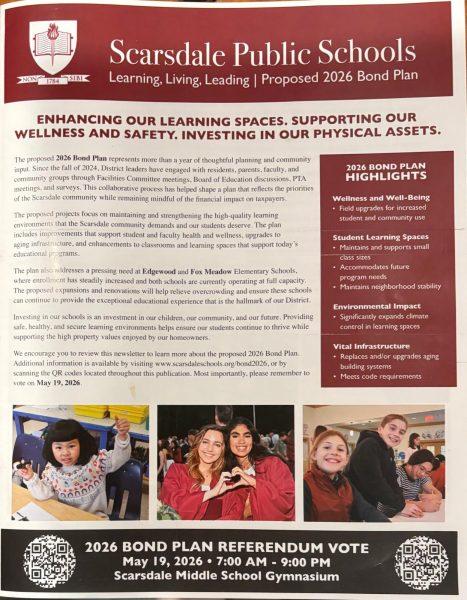
Many members of the SHS Class of 2026 are, or will be 18 years old by May 19th—meaning they have the ability to register to vote on the passing of the bond. In order for these students to make their vote—which they most likely won’t even use—meaningful, they must be informed on the bond’s initiatives. Their non-attendance is a sign that they either will not fulfill their democratic duty to vote, or they will be voting largely uninformed and without questioning.
In terms of students that are unable to register to vote, this presentation still offered crucial insight. The reality is that the passing of this bond affects us all as students in the Scarsdale School District. From softball players who would gain a brand new home field, to lacrosse and field hockey players who would gain a new turf, Scarsdale athletes must be more invested in the bond and its passing. Regarding students that are not athletes, the bond adds brand-new library study spaces, as well as air conditioning in the gym—something students have consistently complained about the lack of for decades. Regardless of whom, the bond touches the daily life of each SHS student directly. No matter their views, students being informed on the direct effects of the bond is imperative.
Additionally, while the proposed bond would add many benefits to student life, it undoubtedly comes at an astoundingly high cost. Although students themselves are not paying, students’ families will be paying the bond’s projects off for 22 years to come. The fact that students did not attend underscores that they have little care for the money their families are spending, an appalling and concerning reality.
This bond has been formed with remarkable attention to student lives and well-being, taking up hours of time from volunteers (including our ex-officio representatives), school faculty, and administrators, to be formed with the most benefit possible. Therefore, SHS students’ disregard for this hard work is disheartening and apathetic.
Most importantly, this bond presentation was an act that embodied democracy. SHS students dismissing it entirely suggests that the state of student civic engagement is weak. While I surely hope this impression is not the reality, the absence of students I discovered greatly concerns me.
As SHS students, we are constantly taught the values of “Non-Sibi,” or “not for oneself .” We are taught about civic responsibilities, and how to fulfill our duties through being informed and asking necessary, thoughtful questions. The absence of students at the bond presentation illustrated that we, as students, do not practice what our district preaches. It made clear to me how we, as students, are becoming less critical thinkers, less globally aware, and less willing to step into the role of change‑makers. It’s about time we change that narrative.
SHS students—next time an opportunity like this comes your away, take a moment to think before you decide to skip it over.