

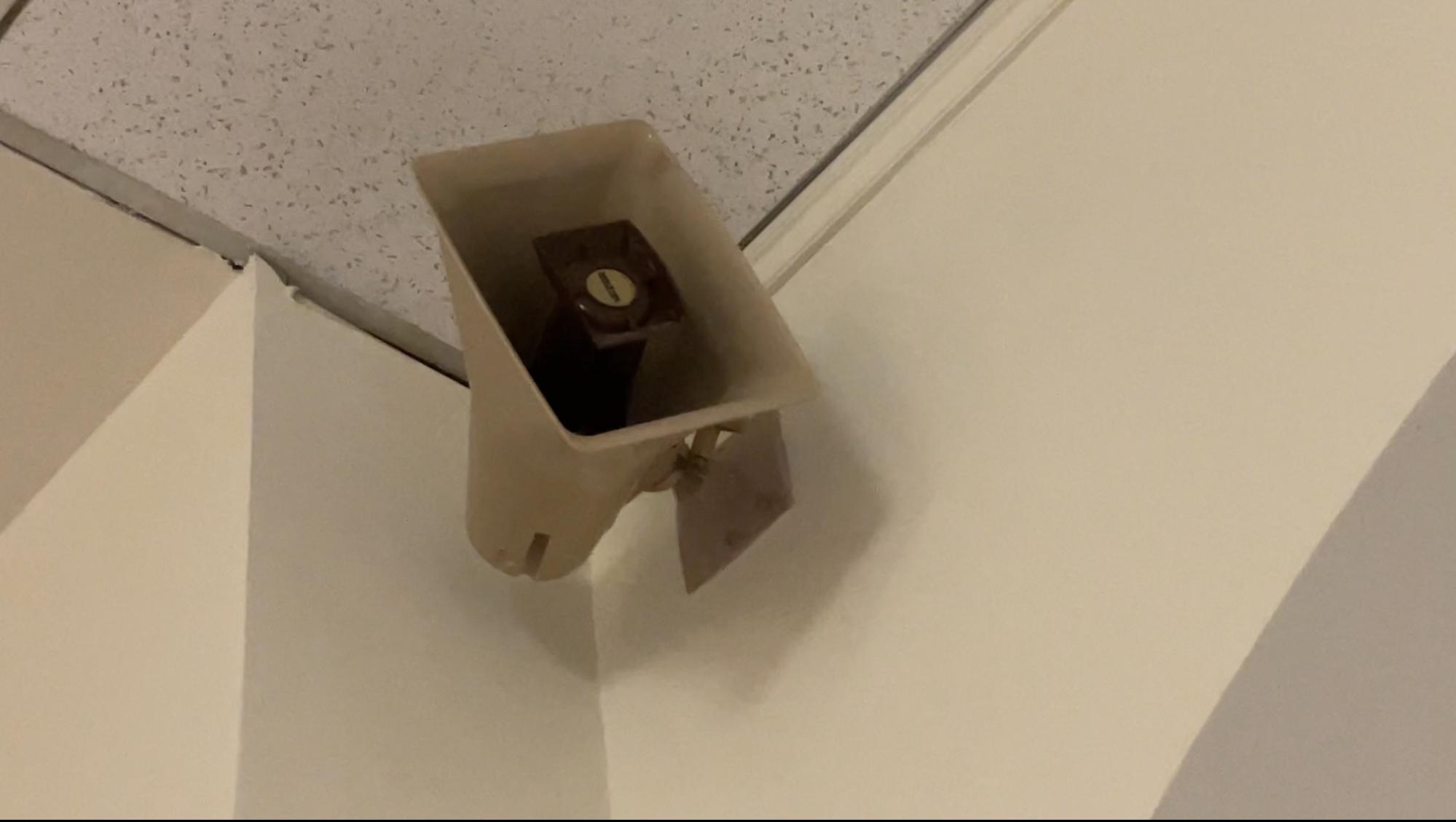
Throughout SHS, speakers are installed in nearly every hallway, broadcasting important messages to students and staff across the building. However, a recent glitch in the Public Address (PA) system—used to amplify volume and make school-wide announcements—has caused the speakers to produce intermittent static sounds which can be heard in classrooms and hallways and create distractions during classes. Tech staff and outside vendors have been working tirelessly to identify the cause and repair the faulty system.
“It sounded like crackling through the speaker,” SHS band teacher Brian Zeller said. While the noises are less noticeable when students are playing their instruments, they sometimes interrupt class while instructions are being given and the room is much quieter. Interestingly, Zeller explained that he remembers hearing similar sounds when he first arrived at SHS roughly four years ago, though the issue eventually faded before unexpectedly returning this year. “When it started again, I [thought] ‘yeah, this happened before,’” Zeller recalled.
Zeller also noted that this issue is present throughout the entire building. Many students and teachers have reported instances of the same crackling sounds in other areas, though according to Zeller, a clear explanation regarding the cause has not been shared with teachers. Although the interruptions are relatively minor, Zeller is hopeful that the school is working toward a solution.
According to SHS IT Manager Michael Basso, the issue appeared to have originated after a series of renovations in the auditorium. Following construction by an external vendor, the speakers mounted on the auditorium catwalk reportedly malfunctioned during announcements, preventing students in the area from hearing them completely. Despite having no clear wiring diagrams for the area, the vendors installed new cables from a nearby speaker in an attempt to restore the system.
After the installation, the speakers in the auditorium began working properly during announcements. “Coincidentally, that is when the [crackling] started,” Basso recalled. The fix seemed to have triggered the current crackling issue, which has since spread throughout the building. The vendors have returned to SHS multiple times, mapping out and pinpointing potential speaker zones that are causing the glitch in the system. Most recently, they revisited the auditorium at the end of April, where they retraced their earliest repair work. While they did not identify specific issues linked to this initial repair, they began considering possible causes based on the arbitrary patterns of the crackling noises.
Basso explained that the latest theory involves a short circuit caused during the renovations in the auditorium. “Something moved, like a piece of metal, so it’s short somewhere,” he said. Part of the difficulty in resolving this issue lies in the sporadicity of the crackling noises. Locating the short requires precise timing: the vendors must be present at the exact moment a malfunction occurs to begin tracing the origin of the issue. Since a speaker may only produce the sounds for a few minutes every hour, fixing the issue has proven to be tedious and time-consuming. “It’s just like finding a needle in a haystack,” Basso said.
Luckily, Basso and the team of vendors have already discussed long-term and short-term solutions. First, they plan to find where the electrical short is in the system and adjust the wiring to prevent further crackling noises. While this fix may suffice in the short-term, Basso believes that SHS cannot continue relying on their current system, which is both outdated and difficult to maintain.
“The whole district really needs to upgrade the PA systems,” Basso urged. “The plan going forward is to digitize and get an Internet Protocol (IP)-based PA system versus an analog based system,” he elaborated. Analog PA systems, which SHS currently relies on, are old-fashioned. These systems require a significant amount of physical wiring, which complicates the troubleshooting process. On the other hand, IP-based PA systems are a more modern technology, which control the audio system digitally, making it easier to monitor while also providing better audio quality. According to Basso, transitioning to a digital system is the ideal long-term solution.
Unfortunately, upgrades to the PA system are not included in the district’s upcoming Capital Projects Bond. While they do not directly impact students’ learning, they still play an important part in daily communication at SHS. In the meantime, the vendors will continue making visits to SHS, working alongside tech staff and custodians to identify the source of malfunction. Ultimately, their goal is to upgrade the entire system to improve reliability and reduce distractions during class periods.





![A screenshot of [@tanyasingerknits]'s Instagram post features the defiled poster placed in a urinal.](https://shsmaroon.org/wp-content/uploads/2026/05/Screenshot-2026-05-02-190834.png)