

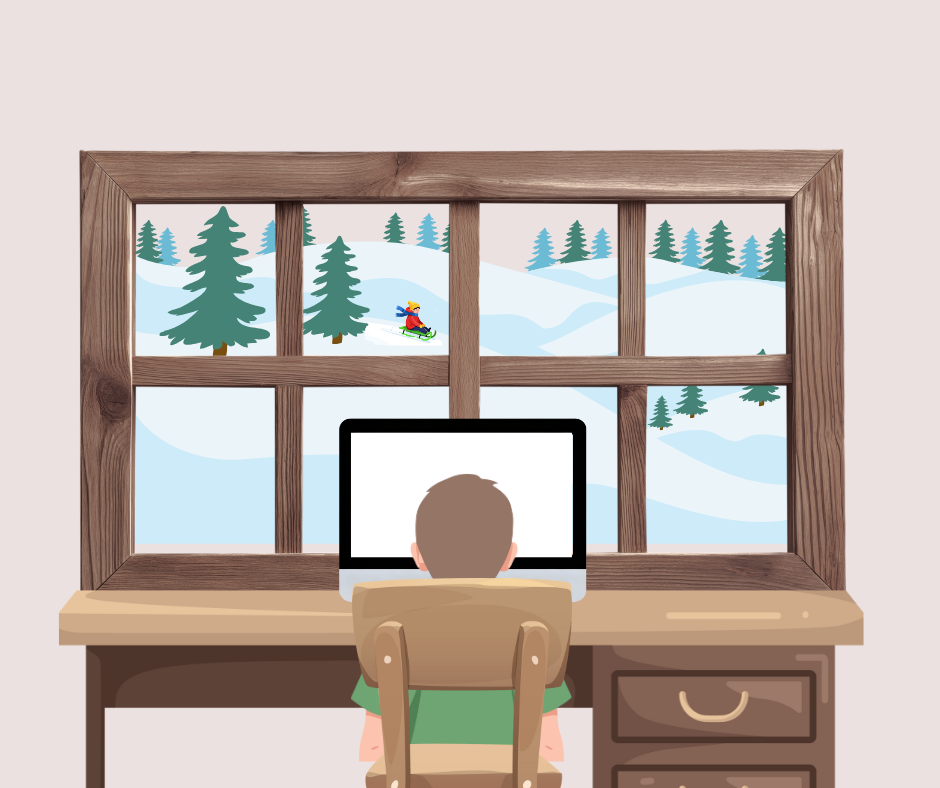
The moment you read the text or email, and then reread it just to make sure you didn’t imagine it, you realize you’ve been given the greatest gift of all…time. Time that was supposed to be structured, measured in bells and deadlines, is suddenly yours to spend as you choose.
Snow day notifications are permission to pause and to exist without immediate expectations. They remind us how rarely students experience unclaimed time. On a snow day, the ownership of time flips. The system bends. In a culture obsessed with productivity and constant forward motion, a snow day decision doesn’t just cancel school, it shifts control, if only briefly, from institutions to individuals.
That permission, however, is disappearing as snow days are slowly eliminated from school calendars. Climate change means fewer storms and technology means fewer cancellations. The true loss, if snow days vanish entirely, won’t just be the opportunity for kids to go sledding or build snowmen. It will be the disappearance of societal acknowledgment of human limits. Snow days recognize that sometimes, physical, emotional, and environmental conditions simply aren’t conducive to learning and therefore it isn’t right to proceed as normal. Critics may argue that students already have time off for holidays, as well as winter and spring breaks, but scheduled breaks respond to the calendar, not to circumstances as they arise. Snow days teach adaptability. They communicate that flexibility is not failure, but wisdom, and that learning to pivot is a critical life skill.
Most often, the immediate concern when inclement weather is imminent is how learning will continue, rather than how students will rest. Some districts activate remote instruction. In others, even without virtual classes, assignments quietly appear online. Free time becomes a logistical problem to solve rather than a human need to respect. It is treated as something dangerous to be “used wisely” and stillness is framed as laziness. In our culture, rest must be justified as busy schedules are worn as badges of honor. Students are praised like professional athletes for achievement, not recovery.
A society that struggles to pause should give us pause. Concern over the normalization of relentlessness as virtue is not just philosophical. Teen mental health research conducted by the Harvard Graduate School of Education shows that demanding schedules and “grind culture” correlate with burnout, while rest and self-care activities reduce psychological distress.
On snow days, something remarkable happens. Students sleep more and slow down, experiencing lower stress levels. The Centers for Disease Control and Prevention’s Youth Risk Behavior Survey warns that as of 2023, most American teenagers are sleep deprived, with only 23% of U.S. high school students getting the recommended eight hours of sleep per night. A University of Oregon study shows that sleeping in on weekends helps teens chip away at their sleep deficit, which is critical to reduce the risk of depressive symptoms, a benefit snow days can support.
Importantly, snow days allow teens to be creative in unexpected ways, to learn to listen to the demands of their bodies, and to manage unstructured time. Teens benefit from downtime in numerous ways as it stimulates creativity and innovation, emotional regulation, independence and motivation, and a sense of balance. These lessons may not appear on a transcript, but they matter. The National Alliance on Mental Illness highlights that adolescents engaging in fun and relaxing activities, for which there normally isn’t time amid intense academic expectations, are important wellness practices during school breaks.
Yet, even before the COVID-19 pandemic, states like Minnesota and Illinois authorized multiple remote or e-learning days per year. During the pandemic, as online teaching improved, a 2020 Education Week survey found that 39% of principals and district leaders opted to convert snow days into remote learning days, with another 32% considering it. In 2022, after the New York Board of Regents authorized remote learning on snow days, former New York City Schools Chancellor David Banks announced, “So, sorry kids—no more snow days, but it’s going to be good for you!” By the start of the 2022-2023 school year, more than three-quarters of states with high average annual snowfall had policies in place to curtail school closures for inclement weather.
So, thank you to school districts like mine, Scarsdale Public Schools, which made the early decision over the weekend to cancel school on Monday, January 26, 2026 in light of the most recent storm, dubbed the “Blizzard of ‘26”. By contrast, New York City announced early Sunday morning the decision to move classes online, with NYC Mayor Zohran Mamdani explaining that the number of school holidays doesn’t allow flexibility to miss a day of school given the 180 days of instruction required by New York state law. He joked, “I know this may disappoint some students, so if you do see me, feel free to throw a snowball at me.” While this humor softens the announcement, it masks the question of what students lose when schools refuse to pause, prioritizing seat-time over students’ mental and physical health.
If districts eliminate snow days entirely, they send the message that efficiency matters more than well-being. Imagine if beyond snow days there are community mental health days that could preserve the need for rest. Maybe whether or not to have snow days isn’t the real question. Maybe the real question is why moments of collective pause feel so rare and radical.