


On a typical morning, students crowd around the second floor of the learning commons, pointing and muttering. The reason? To observe a mouse scurrying through the trash on the stained carpet. The Learning Commons, the two-story space designed for studying and socializing, is becoming an active dumping ground. Half-eaten lunch, abandoned cups, and snack wrappers litter the sofas, chairs, and tables, attracting unwanted pests.
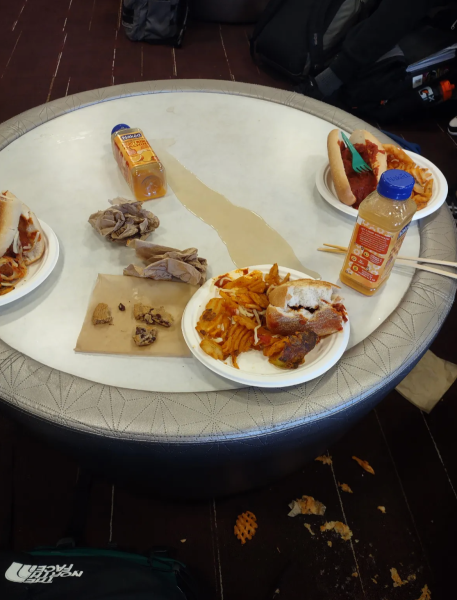
Students not properly disposing of trash most directly impact the custodians, whose job it is to ensure the cleanliness of the space. Every day, garbage piles up, leaving the custodians to vacuum food scattered on the floor, pick up sticky bottles, and gather crumpled wrappers. Students don’t view it as their responsibility to clean up after themselves. Excessive time spent by custodians cleaning up the Learning Commons diverts their attention from equally important tasks, such as tidying up classrooms and sweeping the hallways, making the trash problem an issue for the entire building.
As a popular destination for kids to do homework, the Learning Commons must be a clean environment that supports academic growth and concentration, not a disorganized mess. “Having [the] Commons so dirty and cramped from all the trash makes it hard for me to find spots to do my work,” Evan Lu ‘29 said, a student who studies at the learning commons every day during lunch and free periods. He added, “It’s just common sense for people to clean up after themselves.”
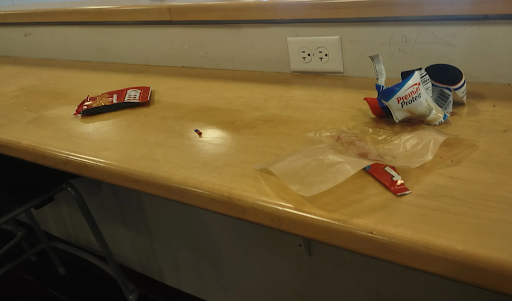
There is also a real financial impact to being reckless with food. A study conducted by the World Wildlife Fund found that 530,000 tons of food, amounting to over 1.7 billion dollars per school year, is wasted by schools. A part of the food waste is caused by improper treatment of food by students. “The concept of no longer having recess and throwing food is now more common,” SHS teacher aide Ray Fitzpatrick said. “For instance, there was a group of students a while back who would throw tomatoes on the ground because they didn’t like them.” Food tossed around in the Learning Commons causes chaos, leaves a mess, and wastes thousands of dollars of food.
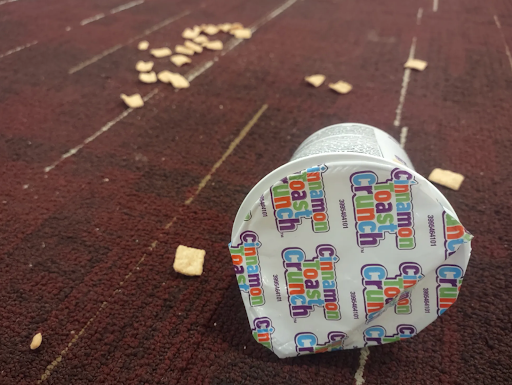
“Students know better than to discard food on the floor, yet it continues to happen. Throwing trash everywhere is certainly not taught in Scarsdale homes,” Fitzpatrick commented.
The trash problem in the Learning Commons is highly fixable. Each student must do their part to clean up after themselves and encourage others to do the same. Keeping shared spaces clean and usable is part of showing respect for the SHS community. By working together and keeping each other accountable, students can transform the Learning Commons environment into one that is more enjoyable and productive for everyone.

![“I personally hope that the passion and anger surrounding stopping [the] Willow [Project] will manifest itself in other climate actions,” Ryan conveyed.](https://shsmaroon.org/wp-content/uploads/2023/03/Green-Minimal-Simple-School-Environmental-Science-Geography-Project-Presentation-900x506.png)

![A screenshot of [@tanyasingerknits]'s Instagram post features the defiled poster placed in a urinal.](https://shsmaroon.org/wp-content/uploads/2026/05/Screenshot-2026-05-02-190834.png)