

A sudden shout of “six-seven,” followed by exaggerated arm movements, has become an oddly familiar sight in everyday life. This incoherent phenomenon has become commonplace in the lives of teenagers around the world. Teachers are well aware of it, and parents can’t ignore it either, even if they have no clue what it actually means.
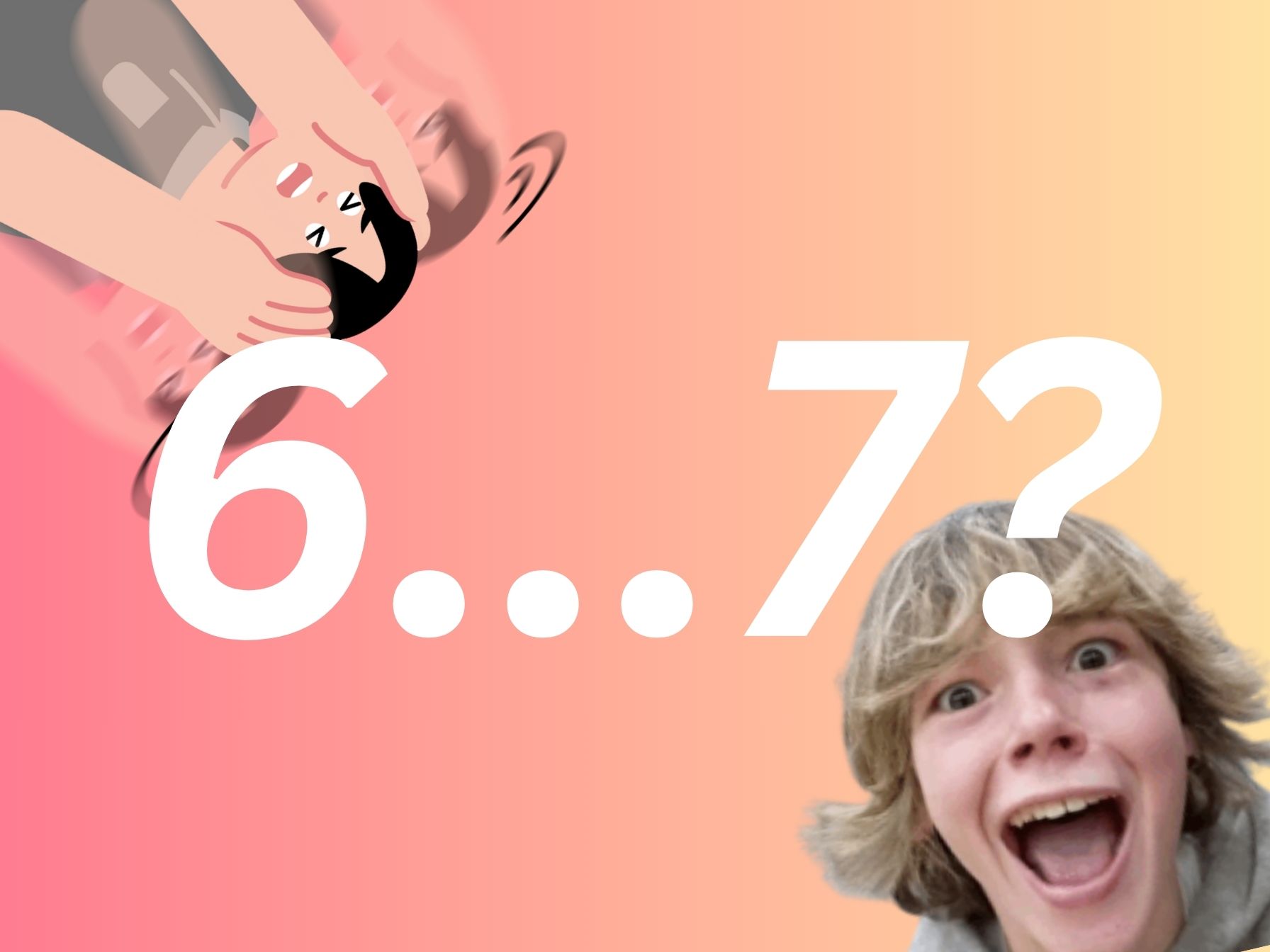
In March 2025, a young blonde boy—later nicknamed the “six-seven kid”—went viral for yelling the term and performing the associated hand gesture at a basketball game, having taken inspiration from basketball player Taylen Kinney. This clip was just a short part of a longer YouTube video, however it was quickly extracted and reposted on countless social media platforms.
The saying originated from Skilla Baby’s hit song “Doot Doot (6 7),” however it never had a direct meaning. Still, this did not seem to matter, and the boy’s popularity exploded. After briefly fading in the spring, the phrase experienced an intense revival in late summer. It was no longer just a few children obsessed with the phrase, but an entire generation.
Users from all around the world joined in, not only filming videos, but using the phrase casually in conversation or to make jokes with friends. Even the mention of the two numbers results in an eruption of laughter—and Scarsdale is no exception.
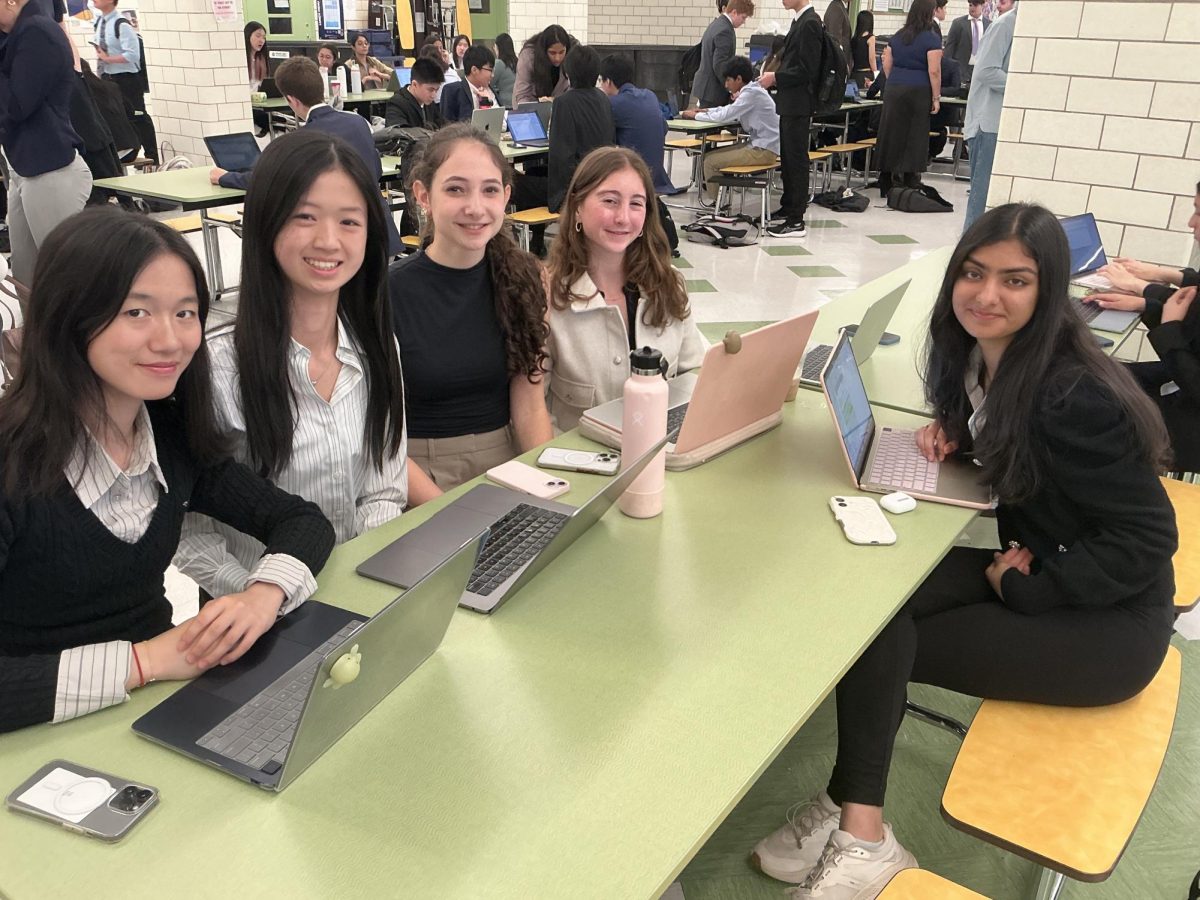
“Whether I’m walking around or in class, six-seven is everywhere around me,” Xiaofei Huang ’27 shared. “I went to the 3D printer for a class assignment, and someone had printed two sets of six-seven.” At SHS, it is inescapable.
“Because those numbers come after each other, it’s really hard to avoid it coming up in daily life and communication,” Dr. John Van Way explained. In math and science classes, where counting is a regular part of classwork and problem solving, the phenomenon is hard to miss. Whether a statistics class is discussing that a histogram should have 6, 7, or 8 bars, or a physics teacher is discussing the gravitational constant, 6.67 x 10⁻¹¹, its presence regularly surfaces in class. “Whenever a teacher accidentally says it, everyone bursts into laughter,” Emery Farnsworth ’29 said.
Some teachers decided to take advantage of the craze to entertain and motivate their students. SHS Physics Teacher Joseph Vaughan incorporated the two numbers into weekly class problem sets. “I would do the math in my head, and then say that I thought the answer would be somewhere between six and seven,” Vaughan shared. Students began to catch on, and it became a fun way for them to enjoy the problem-solving process, even if it was difficult.
The SHS librarians also participated in the use of the internet catchphrase, deciding to switch up the library’s decoration. Library aide Pauline Maloney realized that keeping up with student trends was a great way to increase student engagement, and to get more people coming into the library. “It was definitely to connect with the student body, and to get them to take a look at our boards,” Maloney explained. “We even added books to the boards for when they come and stop by.” Even though the craze may seem over the top, it does have its benefits.
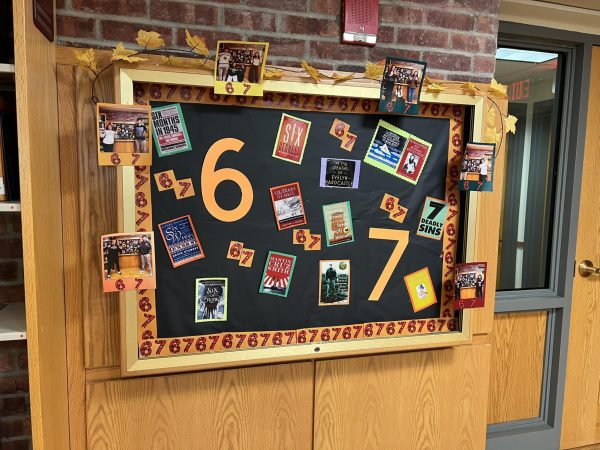
Maloney herself has young children, and has heard six-seven in her own home. Knowing that it could bring more people into the library, she put up a large board with the numbers six and seven. “I have enjoyed taking photos of kids picking Team 6 or Team 7 in front of the board,” Maloney shared. In the past, Maloney has continually made posters of popular teenage trends, constantly changing them in order to adapt to the student body. As trends change, it will be interesting to see how the library decorations will follow suit.
Nonetheless, as time has gone on, the mania surrounding the two numbers has begun to fade. “I feel like as the year goes on, people make less and less of a big deal about it,” Farnsworth said. Even in STEAM classes, where the trend posed the largest issue, teachers have noted that it has begun to die down. “Now, most of the time when it comes up in class, students handle it with maturity, and even if they make a little joke, class moves on without interruption,” SHS Math Teacher Joseph Nista explained. Although its popularity remained at a peak for several months, even evolving into trends such as forty-one and eight-nine, it has begun to fade.
Still, the evolution of six-seven is representative of a larger trend—the omnipresence of “brain rot” in society, especially in younger generations. Brain rot can be described as a collection of nonsensical words and phrases that compose a person’s vocabulary. While they often provide quick and harmless entertainment, many members of Generation Z and Generation Alpha go too far; some from older generations argue that younger generations rely too heavily on these quirky expressions, relevant only to those that are chronically online. Even though six-seven may be coming to the end of its era, there will always be something ready to take its place. The longevity of six-seven serves as a testament for how prevalent brain rot has become in society, and how quickly people adapt to the language spoken around them.
This also speaks to the conformity of society and language, and how people often do things solely for the reason that other people are doing them. If you were to ask a random high school student what six-seven truly means, more likely than not, they would not have a concrete response to give you, even if the phrase made up a part of their day-to-day vocabulary.
Ultimately, six-seven does not seem to have posed a serious problem, despite causing occasional classroom distractions and outbursts; rather, it serves as a case study for the evolution of brain rot among newer generations, and is evidence that this nonsensical slang is not going away any time soon. Society will have to adapt in order to incorporate its use. If anything, this phenomenon will only continue to grow and flourish as more and more people participate in its use.

![A screenshot of [@tanyasingerknits]'s Instagram post features the defiled poster placed in a urinal.](https://shsmaroon.org/wp-content/uploads/2026/05/Screenshot-2026-05-02-190834.png)